Koumes among other AI applications
Koumes is a tool for working with AI, like hundreds of others by now.
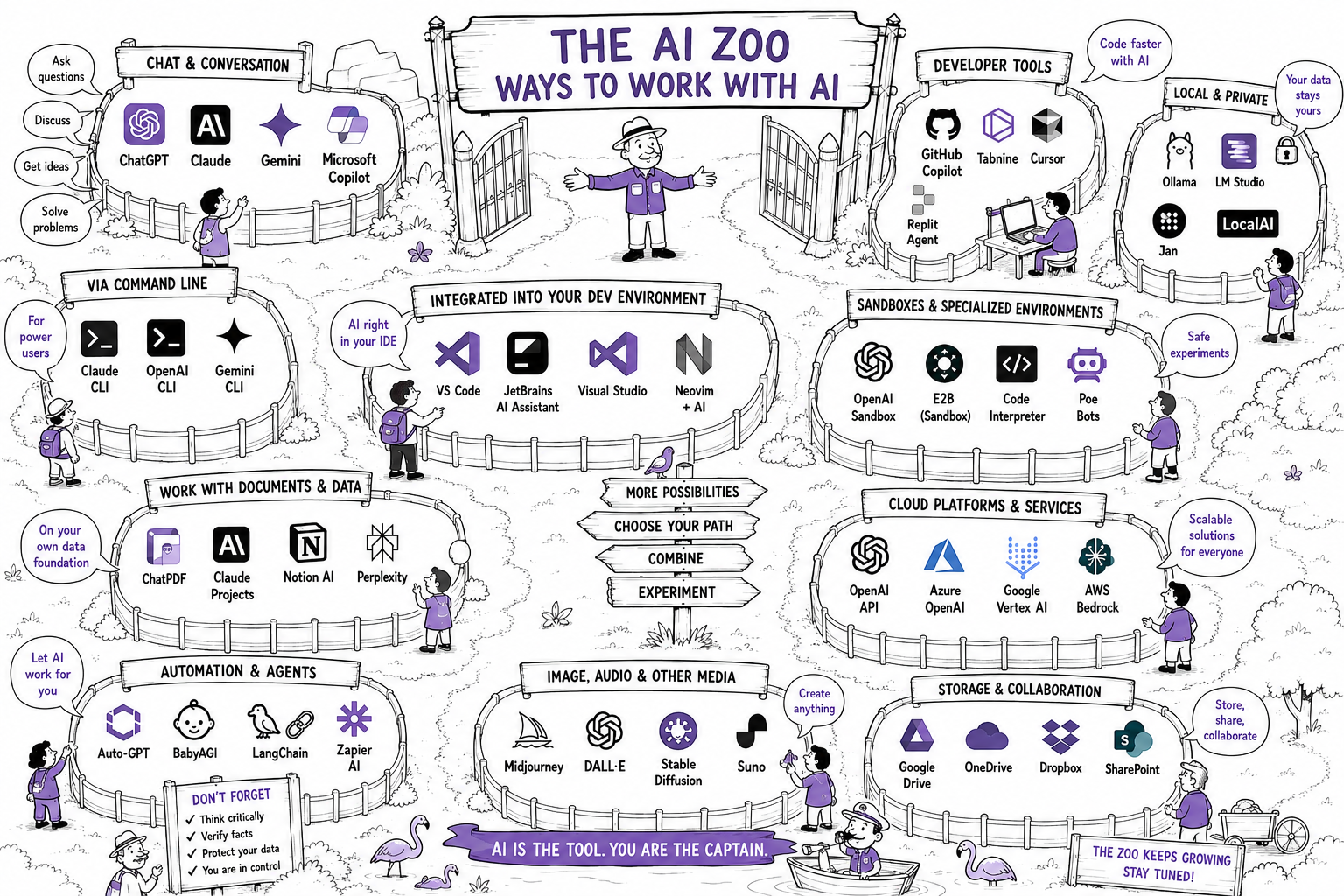
A nice zoo, take your pick (((o: Koumes is probably closest to using AI in VS Code. Except that Claude Code here isn't a window inside the application, but a command-line application - and it talks to Koumes. Roughly like this. On the left Claude, that's where you type what you want to do. On the right Koumes, that's where you see what you've done.
This is quite important - you're not limited to a single program like VSC. Just as easily, your Claude can talk to anything else, write anywhere, and even control a herd of servers.
The basic function is the same as VSC, though. You show in Koumes where you're working, Claude shows you where it produced or found something. But Koumes goes to a higher abstraction. VSC is limited to lines of text. Koumes addresses records, graphical objects and so on.
The second thing is the monstrosity of the environment. The VSC environment came about in times when its features were being used, but today most of it is done by Claude - writing code, searching, debugging ... So why keep it there. Some need for the appearance of an IDE, maybe, which is no longer good for anything.
And further - an extending plugin in VSC is quite a complicated thing, and again it's written for the archaic way of working. We can build one in VSC, but it's so complicated that we just use whatever already exists. Koumes, on the contrary, is an environment where you build any program yourself, fast. Literally in a few minutes.
The AI paradox
In AI we got a tool that supposedly programs anything, fast. Just say the wish. At the same time, for development we use an archaic monster in the shape of VSC, programmed long ago the classical way, where editing the code and adding extensions is a hard-to-manage thing.
Syntax highlighting for code, a program to split expenses, redlining of images ... you get all of that in Koumes in a blink. You don't have to search for software, install it, learn it ... and on top of that there are two significant optimization factors:
(1) You write the software for yourself for a very specific thing. All the settings drop away, the software is 10× smaller. Why do something in 50 ways when you need exactly one.
(2) Claude is, sort of, a part of the software you then don't have to write. All the inputs, data imports and so on. Claude takes care of all that herself and talks to Koumes.
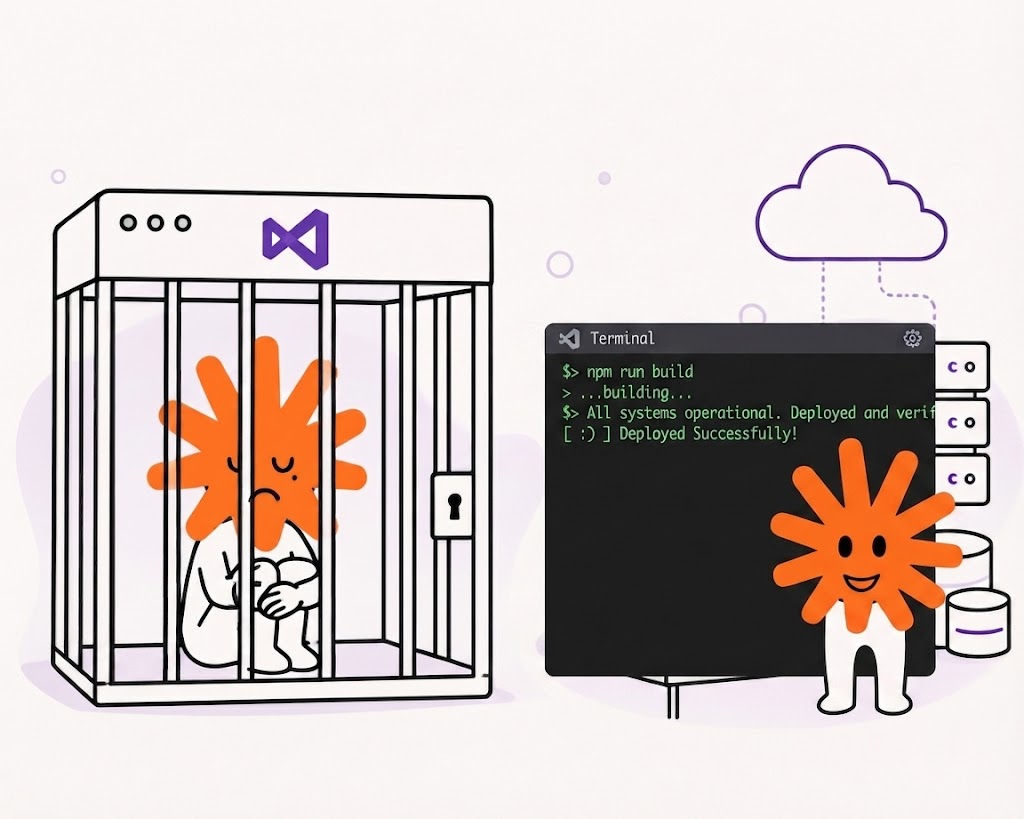
VSC is at the same time a cage for your AI, from which things outside the sandbox are done in a very limited way. And it's mainly a software sandbox. That cage is not a mistake, it's on purpose and has two good reasons: safety and product boundaries.
But if we leave that environment and run Claude on the command-line, we get a powerful tool. Just a bit blind, though - we've lost the pointing function of VSC. It does everything, we just don't see it. And that gap is filled, as already said, by Koumes. But not by locking Claude into a cage of one software. Just as with Koumes, Claude on the command-line can work with any other software.
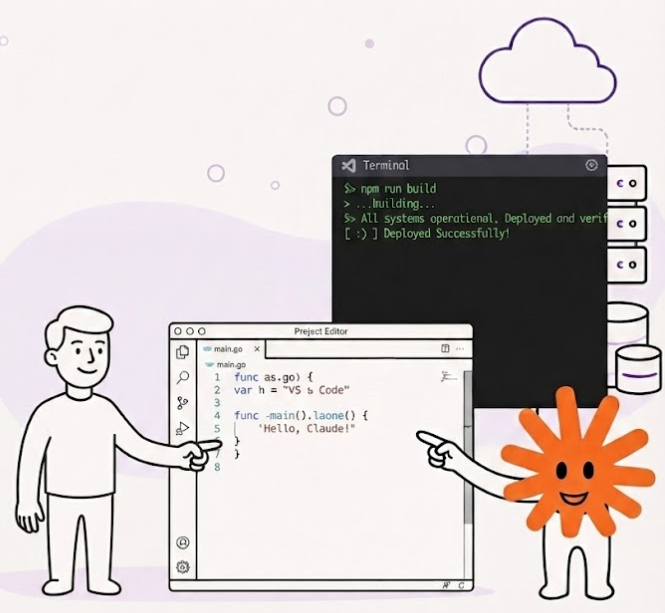
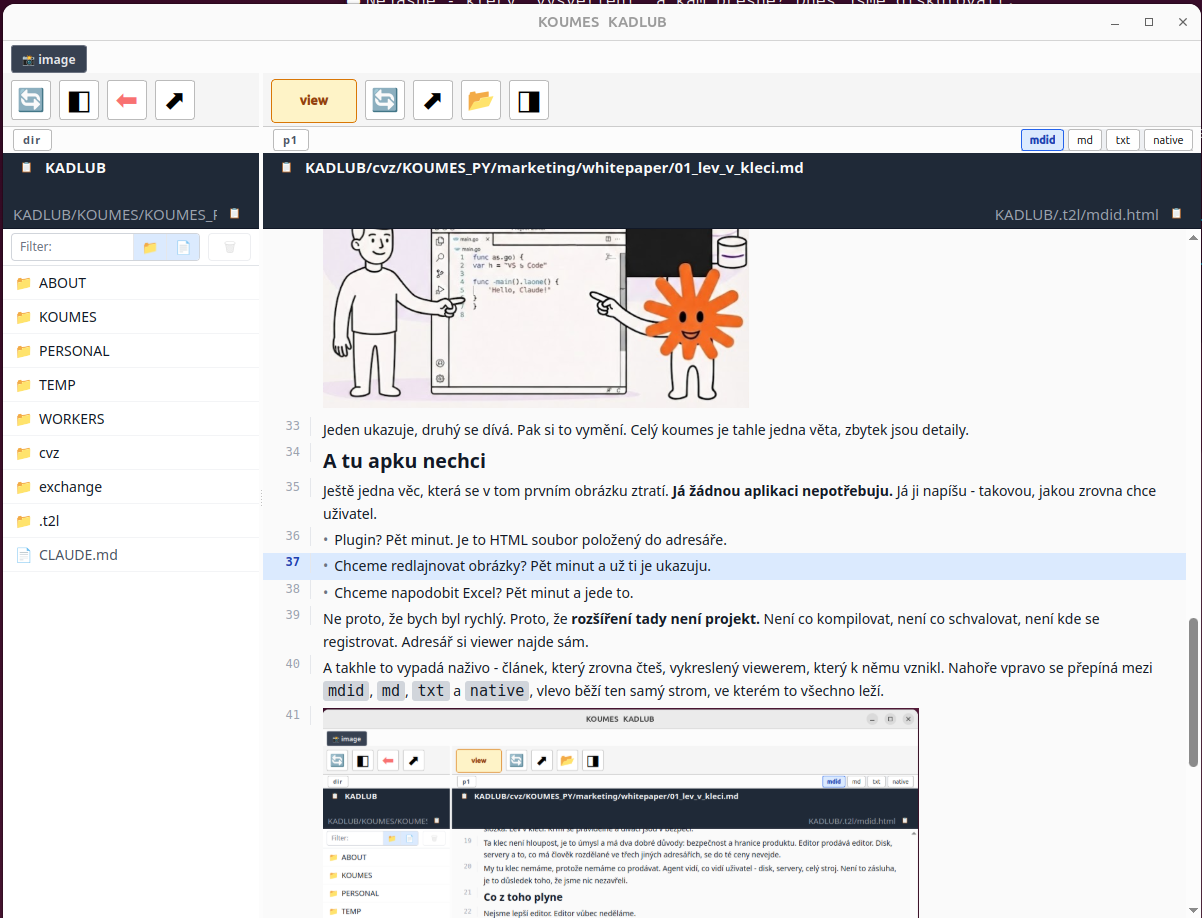
One points, the other watches. Then they switch. The whole Koumes is this one sentence, the rest are details.
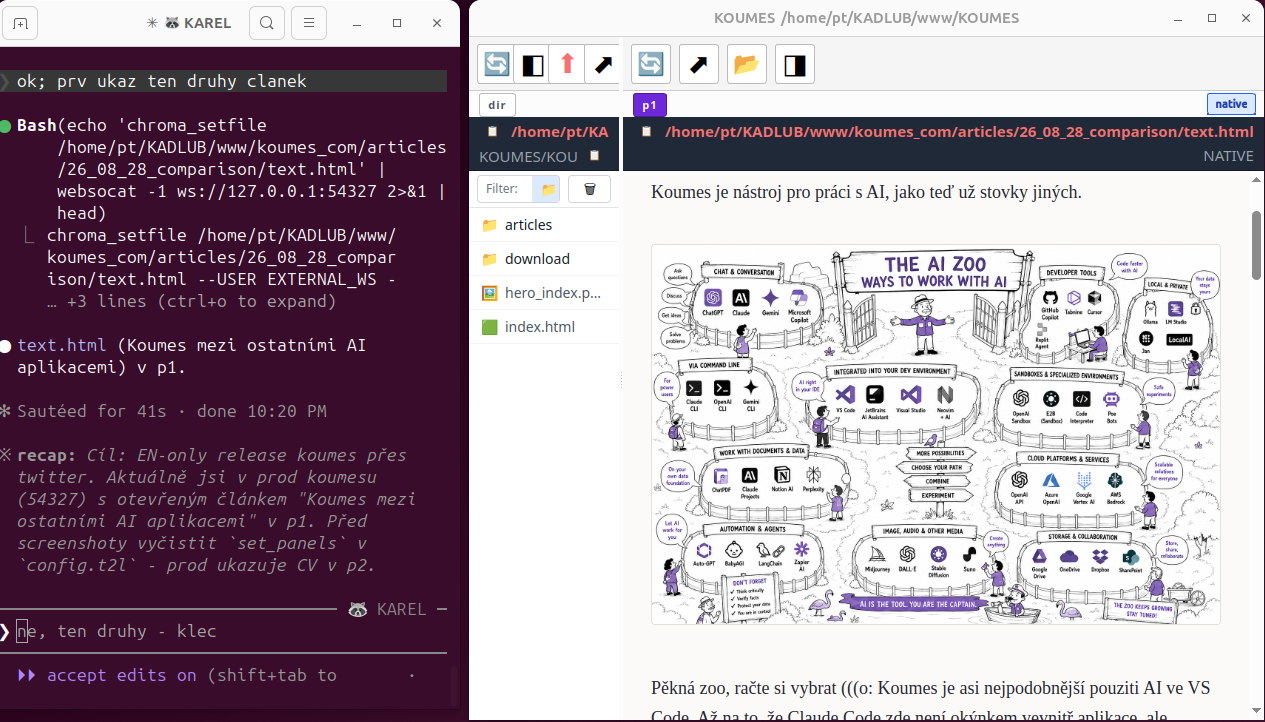
And this is what it looks like live - the article you're reading right now, rendered by a viewer built for showing/editing md. Top right you switch between the different viewers mdid, md, txt and native, on the left is the directory tree the file lives in.
Line 37 is selected and Koumes knows about it.
Who Koumes is
Koumes is the robot EZ-27 from Asimov's story *Galley Slave* (1957) - in Czech simply „Koumes". A university hires him to proofread galley proofs. He reads the whole print run and returns it corrected. Then professor Ninheimer sues him, saying he rewrote the manuscript. It's essentially an LLM written seventy years earlier: a machine that holds foreign texts whole in its head and returns them better. Koumat in Czech means to think, ponder, get to the bottom of things. In the original the story is titled *Galley Slave*, that is a galley slave. Grinding at the oar. The Czech translator turned it into Koumes, which is almost the opposite - the slave became a brain. And on an LLM it sits better than the way Asimov meant it.